Page contents
What is the drag coefficient of a sphere and how is its drag calculated?
The drag coefficient Cd of a sphere is not constant: it depends on the Reynolds number Re = V D/ν. At very low speeds (Re < 1, Stokes regime) Cd = 24/Re and drag is proportional to velocity; between Re = 1,000 and 2×10⁵ Cd stays close to 0.47 and drag grows with the square of velocity; around Re = 3×10⁵ comes the drag crisis: the boundary layer turns turbulent, separation moves aft, the wake narrows and Cd drops to 0.1 before rising again to about 0.2. The force is F = ½ ρ V² S Cd with S the frontal area πD²/4. Example: a 100 mm ball at 20 m/s in air (Re = 1.3×10⁵, Cd = 0.47) feels 0.5 × 1.204 × 400 × 0.00785 × 0.47 = 0.89 N.
Drag formulas for a sphere
- F: drag force, in N; ρ: fluid density, in kg/m³; V: relative velocity, in m/s
- S: frontal area of the sphere, in m²; D: diameter, in m
- Cd: drag coefficient, dimensionless, read from the table below according to Re
- ν and μ: kinematic (m²/s) and dynamic (Pa·s) viscosities of the fluid
Drag coefficient of a smooth sphere against Reynolds number
| Reynolds number Re | Regime | Cd |
|---|---|---|
| 0.1 | creeping (Stokes), Cd = 24/Re | 245 |
| 1 | creeping, symmetrical streamlines | 27 |
| 10 | toroidal vortex at the rear | 4.1 |
| 100 | unsteady wake | 1.1 |
| 1,000 | subcritical, laminar boundary layer | 0.47 |
| 10,000 | subcritical | 0.41 |
| 100,000 | subcritical, separation near 80° | 0.47 |
| 300,000 | drag crisis, separation near 120° | 0.10 |
| 1,000,000 | supercritical, turbulent boundary layer | 0.20 |
Detailed explanations and calculation in Mecaflux
The case of the sphere in aerodynamics and hydrodynamics is particularly interesting because it highlights the relationship between the Reynolds number and drag  Re<1: At low speeds, the current lines are symmetrical. Two points stopping are observed A1 et A2. It is creeping flow regime.
 Re=4: If Re increases, the detachment appears to the rear of the sphere along a circle S in conjunction with a vortex-ring centered on the axis of the sphere.
 Re=10 Increasing Re, the vortex increases in volume to fill all the back of the sphere and the circle of detachment S is substantially diametrical.
 Re=14,
the swirl Detaches and takes a helical shape while the sphere is subjected to a transverse force revolving around u, the flow regime is not continuous but continuous on average.
 Re=100,it appears a circle of detachment at 10° on the front of the sphere. Behind The wake is an area where the speed varies statistically around a mean value of zero.
 Re =(1Oe5 à 10e6), The circle of detachment suddenly shifts back and the wake is reduced.
It is assumed that :
-
at Re<(1Oe5 à 10e6), the separation occurs in the Laminar Boundary Layer.
-
at Re>(1Oe5 à 10e6), the separation occurs in the turbulent Boundary Layer.
-
atr Re =(1Oe5 à 10e6),
there is detachment at the transition point of the boundary layer. . The value of Re depends greatly on the state of the surface of the sphere .The value of "Re sudden movement of the circle of detachment" is lowered by increasing the roughness of the sphere, This precipitates the onset of turbulent boundary layer.
Variation coefficient of drag (cd) of a sphere (line) and a disk (dotted line) as a function of the Reynolds number

Variation coefficient of drag of a cylinder of "endless length" perpendicular to the fluid stream, as a function of the Reynolds number:

see: Reynolds , hydrodynamique
With MECAFLUX standard
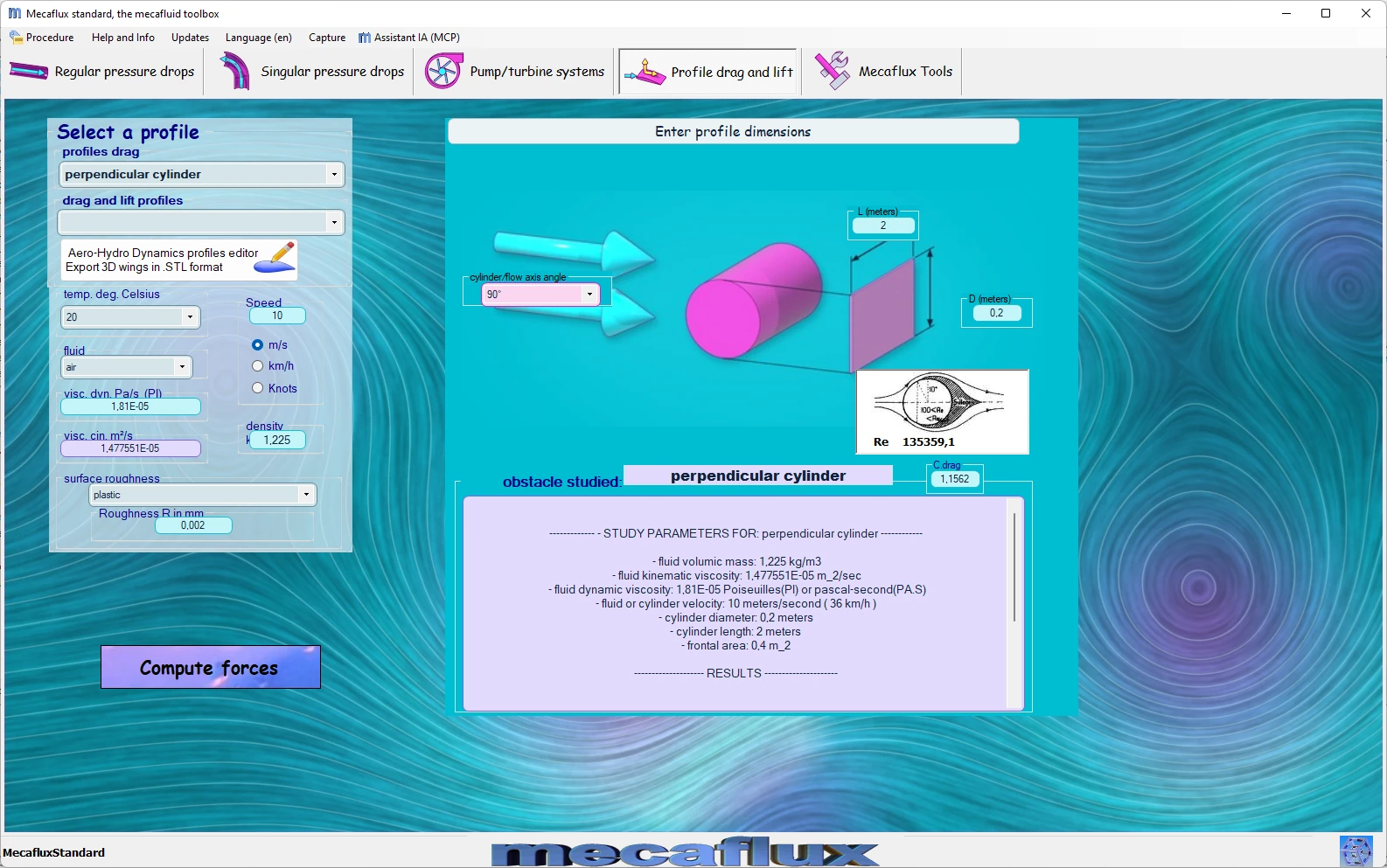
Enter the diameter and roughness of your area, choose the fluid, enter the flow velocity, and Cd and the drag force in Newton, will be given depending on the Reynolds number
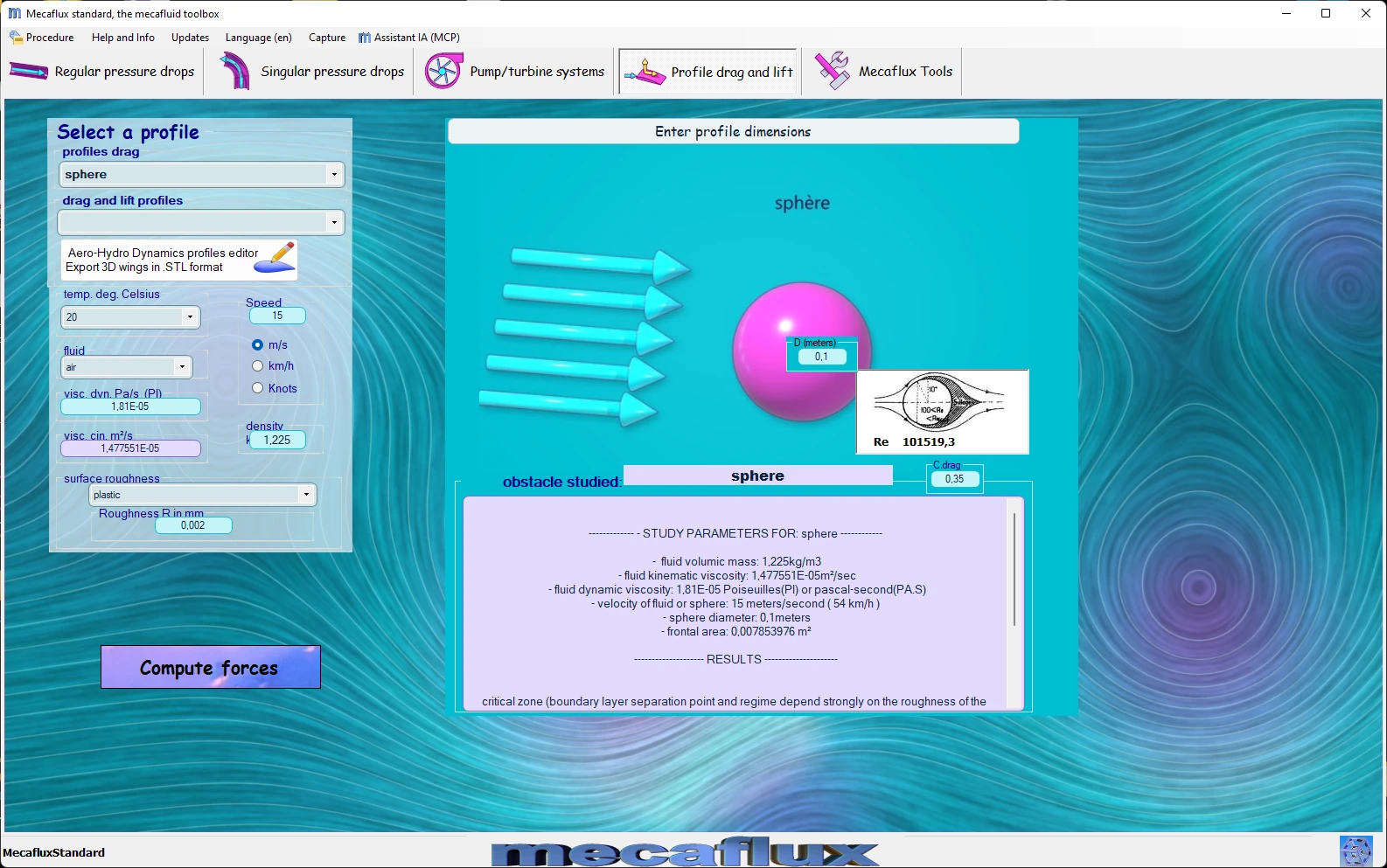
Mecaflux integrates (in the drag and lift tab), the calculation of the drag of spheres and perpendicular cylinder of given length by applying a correction function of the length / diameter ratio of the cylinder. The angle can also be parametered (90/60/30/0):
Frequently asked questions
Why does the drag of a sphere drop suddenly around Re = 3×10⁵?
Because the boundary layer becomes turbulent before it separates: being more energetic, it stays attached longer and the separation point moves from about 80° to 120° from the stagnation point. The wake, hence the rear suction, shrinks and the drag coefficient falls from 0.47 to 0.1. The dimples of a golf ball trigger this transition from Re ≈ 5×10⁴, which lets it fly twice as far as a smooth ball.
What is the terminal velocity of a sphere falling in a fluid?
It is the velocity at which weight minus buoyancy equals drag. In the Stokes regime (Re < 1) it is v = (ρs − ρ) g D² / (18 μ): a 0.1 mm grain of sand (2,650 kg/m³) falls in water at 9 mm/s, i.e. 32 m/h. For larger particles one iterates with the Cd of the table; see the sedimentation page.
Is the drag coefficient of a cylinder the same as that of a sphere?
No. A cylinder of infinite length across the flow has a Cd of about 1.2 between Re = 10³ and 2×10⁵, falling to 0.3 after the crisis; a short cylinder is less resisted thanks to the flow around its ends (Cd ≈ 0.63 for L/D = 1, 0.74 for L/D = 5, 0.82 for L/D = 10). A disc facing the flow keeps a Cd of 1.1 whatever Re above 10³: its sharp edges fix the separation.
How do I calculate the drag of a sphere, a cylinder or an object in my own project?
In the drag and lift tab of Mecaflux Standard you enter the diameter and roughness of the sphere, pick the fluid and its temperature and the velocity: the software gives the Reynolds number, the Cd and the force in newtons; it also handles a cylinder of given length, with the length correction and the angle of attack (90, 60, 30 or 0°), and the usual geometric shapes. For an object carried, towed or immersed in your installation, Mecaflux carries out the study of your project, or offers training on the software applied to your own case.